Vail's Housing Story Starts in 1980, Not 1880
Vail has been on the map since the 1870s, when the Vail brothers ranched here and Walter Vail donated the land that put a railroad stop — and a name — on this stretch of southeast Pima County. The place was christened a town in 1893 and has never actually incorporated. But almost none of that history is standing in anyone's living room. Vail's residential story really begins in 1980, when IBM announced a major plant in southeast Tucson and turned a rail siding and a school district into a growth corridor. Vail School District enrollment reached a thousand students by 1990, and the subdivisions followed the schools.
What that means for ceilings is unusually clear-cut. The overwhelming majority of Vail's housing — Rancho del Lago, the Del Webb-era build-out of the early 2000s, the newer Rocking K community going up now with Pulte, KB Home, Lennar, and Richmond American, and most of the subdivisions off Old Vail and Colossal Cave roads — was framed decades after asbestos disappeared from spray-applied ceiling texture. Asbestos left these products in the late 1970s. If your Vail house has a build year starting with a 9 or a 2, you are almost certainly not looking at an abatement project, and you should be skeptical of anyone who suggests otherwise.
The exception is real, though, and it has a specific address. Corona de Tucson was planned in 1963 under the name New Tucson — a retirement community for Baptist church members, whose congregation pledged to buy the first seventy-five houses. Those original blocks, along with the homes that filled in around the Santa Rita golf course through the 1970s, sit right inside the popcorn-ceiling era. So do the ranch houses, homesteads, and older site-built homes scattered along Colossal Cave Road, Old Spanish Trail, Marsh Station, and out toward Mescal. On any of those, a lab test comes first, without argument.
Reading Your Own Vail Ceiling
- Start with the assessor, not the ceiling. Pima County's year-built record settles more than a visual inspection ever will. Pre-1980 means test. 1980 to about 1990 means test if the install date is at all uncertain. After that, the risk is effectively gone.
- Mailing address is not build era. Plenty of Vail-area homes carry Tucson mailing addresses in the 85641 and 85747 ZIPs, and plenty of "Tucson" listings are really Vail. The parcel record, not the envelope, tells you the vintage.
- Newer does not mean untextured. Late-90s and 2000s Vail builders sprayed a lot of heavy knockdown, and some bedrooms and garages got a light acoustic ceiling. It is dated, it is worth removing, and it carries no asbestos concern at all — compare the finishes.
- Additions are their own house. A 1974 Corona de Tucson original with a 2003 family room has two eras under one roof. Sampling is done per area, not per address.
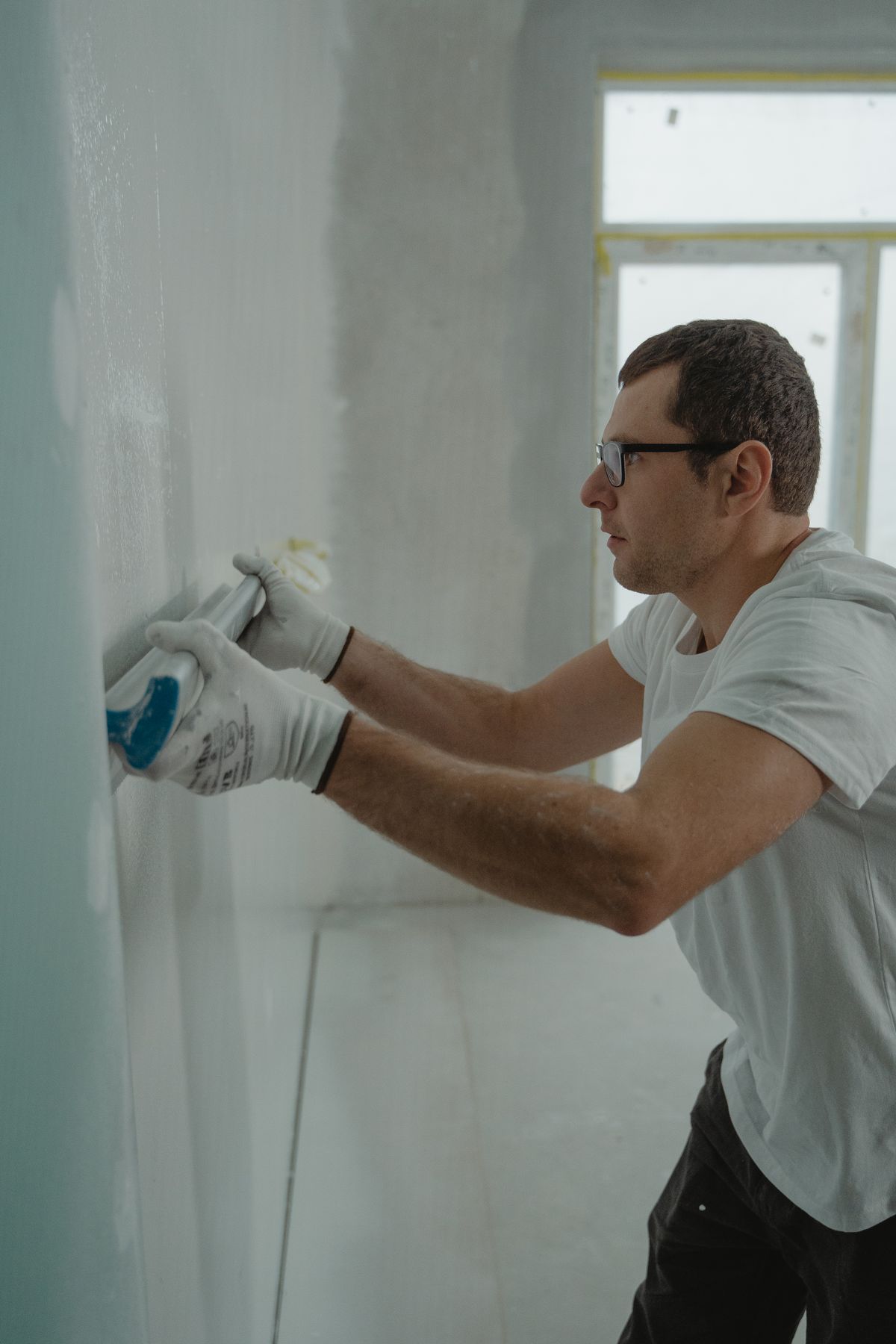
What Vail Homes Actually Need
The typical Vail call is a modernizing project rather than a hazard project. Twenty- and twenty-five-year-old builder texture — heavy knockdown on every ceiling, orange peel everywhere else — is the single loudest signal that a house is from the last building boom rather than this one. Flattening those ceilings to a smooth or light finish, then repainting, is the cheapest whole-house visual update available, and it photographs dramatically better for a listing.
The second call is repair. Vail sits on expansive desert soils, and homes from the early 2000s are now old enough to show truss-lift cracks along the ceiling-to-wall joint, nail pops down the joist lines, and monsoon staining around roof penetrations and skylights. Those get genuine drywall repair and texture blending, not a coat of white over the ring.
Common Vail Projects
Knockdown to smooth
Rancho del Lago and Old Vail-corridor homes of 1,800–2,600 sq ft taken from heavy builder knockdown to a flat, modern ceiling. Usually 4–6 working days including paint.
Corona de Tucson originals
The 1960s and 70s core gets the full test-first sequence: lab sample, containment, wet scrape, skim, retexture, paint — and honest options if a result comes back positive.
Acreage and ranch homes
Older properties along Colossal Cave Road and Old Spanish Trail often mix eras and materials. Gate codes, long drives, and trailer parking get sorted before the crew rolls out.
Two-story entries and great rooms
Vaulted ceilings and two-story foyers are standard in 2000s Vail plans. Height is handled with planking and scaffold, and it is priced honestly rather than treated as an obstacle.
Living Through a Vail Project
Most Vail jobs happen in occupied homes with furniture, kids, and pets, which puts containment at the center of the whole thing. Floors and walls get sealed in plastic, doorways are taped off, supply and return registers are covered so nothing travels through the ducts, and power to ceiling fixtures is shut down before anyone starts. Work is staged room by room so the house stays livable, and the plastic comes down with the house cleaned rather than merely swept.
Distance, Access, and Scheduling
Vail sits roughly 20 to 25 miles southeast of downtown Tucson, mostly a straight run down I-10 or Old Spanish Trail. That distance is exactly why some Tucson contractors quietly inflate quotes for the drive or decline single-room jobs out here. Vail is core service territory here, right alongside neighboring Rita Ranch, Tanque Verde, and Sahuarita — the mileage does not become a line item.
Scheduling in Vail has one nice local advantage: a lot of homes here are on larger lots with garages, side yards, and room to stage. Containment, debris, and equipment all stay out of the neighbors' way, which makes multi-day projects far less disruptive than the same work in a tight midtown lot. If you have a move-in date between closing and furniture, that empty window is by far the cheapest and cleanest time to do the whole house at once.
The other Vail scheduling quirk is the school calendar. So much of this community exists because of the Vail School District that family calendars here bend around it, and summer break is the most requested window of the year for whole-house work. Booking early matters if that is your window; spring and fall are quieter and easier to schedule tightly.
What It Costs in Vail
Vail pricing follows the metro ranges in the Tucson cost guide: about $1 to $3.50 per square foot to scrape texture that tests negative, and roughly $3 to $6 per square foot for a finished, painted ceiling. Two things move a Vail number. Painted texture — common here, because builder spray was almost always sealed — resists water and takes longer to remove than raw acoustic material. And vaulted or two-story spaces need real access equipment, which shows up in the quote as its own line rather than as a mystery surcharge.
Vail FAQs
Our house was built in 2004. Should we test the texture anyway?
No, and you should be told that plainly rather than sold a test. A 2004 build is roughly a quarter-century past the point where asbestos was used in ceiling texture. The only reason to sample a house that new is if one room's material is visibly different from the rest. More on testing.
Where exactly do you serve around Vail?
Vail proper, Corona de Tucson, Rancho del Lago, Rocking K, the Old Vail and Colossal Cave corridors, and the acreage properties out toward Marsh Station and Mescal — plus adjacent Rita Ranch and the rest of southeast Tucson.
Can one or two rooms be done instead of the whole house?
Yes. Single rooms are usually 1–2 days including refinishing and paint. The one caution is matching: if the rest of the house keeps its texture, the finish is chosen and blended so the transition does not announce itself at every doorway.
Is it worth doing if we're staying put for another ten years?
That is genuinely a personal call, but two things tend to decide it. Dated texture bothers people more the longer they live under it, and doing the work while you are still in the house means you get years of the benefit rather than handing it to a buyer. The counterargument is disruption — it is a multi-day project in an occupied home. Either way, the quote is free and there is no obligation attached to asking.
Will the ceiling get repainted, or just refinished?
Refinishing and painting are quoted together by default, because a bare skim coat is not a finished ceiling. Stain-blocking primer plus flat ceiling paint is standard, and whole-house ceiling painting can extend to rooms that are not being scraped.
Free Quotes Across Vail
Straight answers about whether your ceilings need testing, what they need instead, and what it will actually cost.