Why Rita Ranch Almost Never Needs an Asbestos Test
Rita Ranch is a master-planned community of more than twenty named subdivisions on Tucson's southeast edge, home to roughly twelve thousand people. Its oldest sections date to the mid-1990s — stucco ranch homes in the 1,200 to 1,600 square foot range on standard lots — and the bulk of it went up from the late 1990s into the early 2000s, with the newer subdivisions pushing past 2,000 square feet on open-concept plans with two-car garages. Growth has continued east and south ever since.
That build history answers the asbestos question before anyone climbs a ladder. Asbestos was pushed out of spray-applied ceiling texture in the late 1970s, and even allowing for installers working through leftover stock, the material was gone from new construction long before the first Rita Ranch slab was poured. A home built in 1996, or 2001, or 2004 has effectively no realistic exposure. If a contractor arrives at a Rita Ranch address and starts quoting abatement pricing, ask them what year they think your house was built.
That is worth saying plainly because "popcorn ceiling" and "asbestos" have become a reflex pairing, and the reflex costs Rita Ranch homeowners money. The correct answer here is usually no test needed, which makes these projects simpler, faster, and considerably cheaper than the same work in a 1965 house across town. The narrow exceptions are worth knowing: a parcel with an older structure predating the subdivision, or texture in one room that is visibly different from the rest, which can point to unrecorded earlier work. In those cases one inexpensive sample settles it — here is how testing actually works — but for the overwhelming majority of Rita Ranch homes, it simply is not part of the job.
What These Houses Actually Have
- Heavy builder knockdown. The signature Rita Ranch ceiling is a thick sprayed knockdown that was standard on 1990s and 2000s tract construction. It is not hazardous, but it reads unmistakably as of its decade next to the smooth ceilings in newer southeast Tucson construction.
- Light acoustic spray in odd rooms. Some mid-90s builds got a fine sprayed acoustic ceiling in bedrooms, closets, or garages. It looks like popcorn's younger cousin and comes off easily — without any of the testing overhead an actual 1970s ceiling would carry.
- Thirty-year-old drywall. Homes from the first Rita Ranch subdivisions are now old enough to show truss-lift cracks along the ceiling-to-wall joint, nail pops down the joist lines, and monsoon-season stains at roof penetrations. Those want real drywall repair before any refinishing goes over them.
- Vaults and two-story entries. The later subdivisions brought nine-foot ceilings, vaulted great rooms, and two-story foyers. Height changes the access plan and the price — planking and scaffold rather than a stepladder — and it should appear in the quote as its own line.
- Dust, constantly. This is open desert flats along the I-10 corridor, and textured ceilings hold every bit of what blows in. Smooth ceilings wipe clean; knockdown does not.
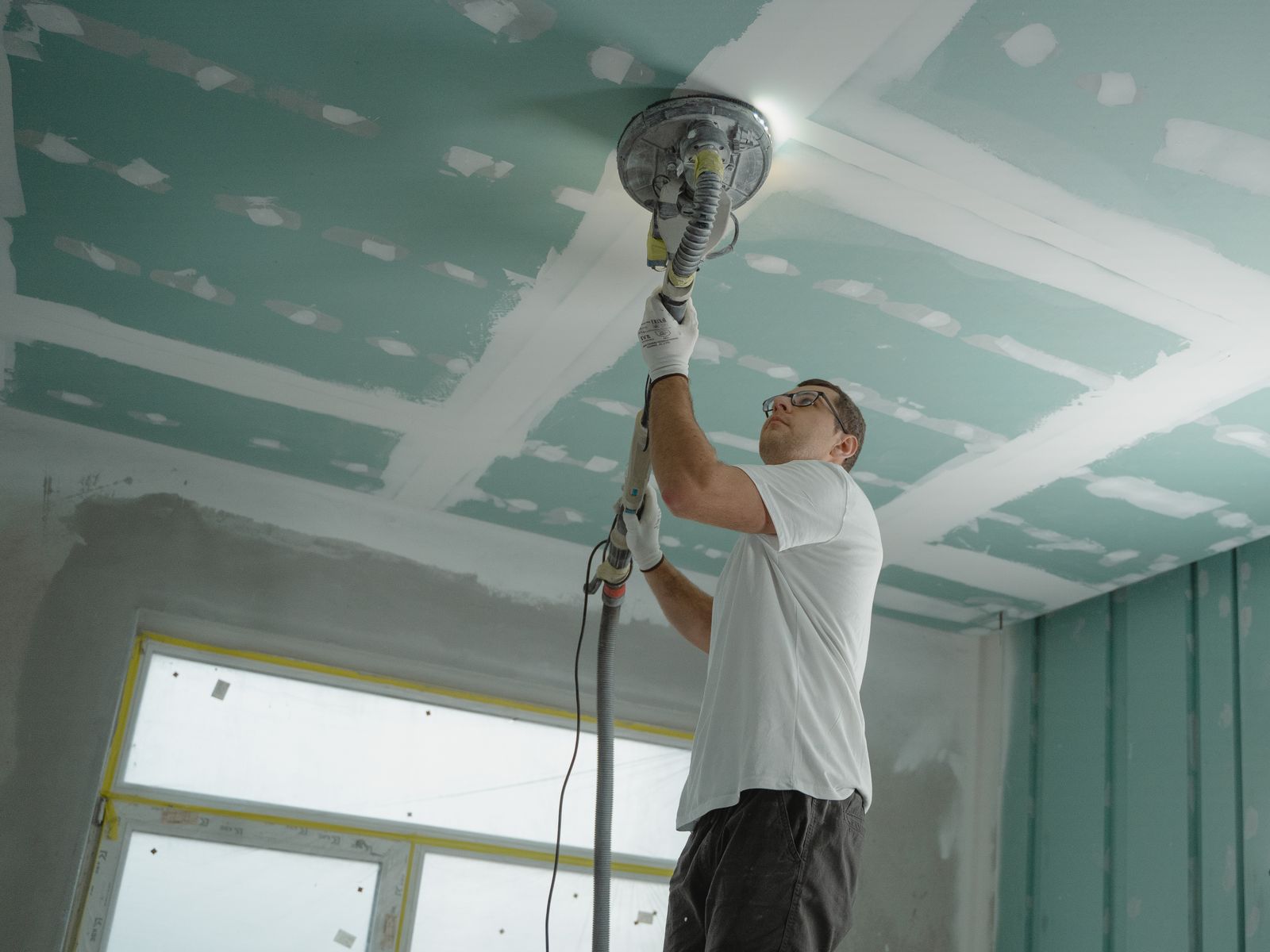
Base Turnover Makes This a Timing Question
Rita Ranch draws heavily from Davis-Monthan Air Force Base, Raytheon, and the I-10 employment corridor, along with first-time buyers priced out of midtown and families who want Vail School District access. That mix means the neighborhood turns over on a rhythm most Tucson subdivisions do not have: PCS orders, rental transitions, and short windows between one household leaving and the next arriving.
Those windows are the cheapest possible time to do ceilings. An empty house needs no furniture protection, no room-by-room staging, and no living around plastic sheeting, and it typically quotes noticeably lower than the same work in an occupied home. If you are listing, renting out, or moving in, sequencing the ceiling work into that gap is the single best money-saving move available — and pairing it with whole-house ceiling paint in the same visit costs far less than bringing someone back later.
Common Rita Ranch Projects
Knockdown to smooth
The signature job out here: flattening dated builder texture across a 1,400–2,200 sq ft plan and repainting. Usually 3–5 working days, and it modernizes the whole interior at once.
Between-tenant refresh
Rental and PCS turnovers scheduled into a tight vacancy window, with ceilings refinished and painted before the next household moves in.
Crack and stain repair
Truss-lift separation, nail pops, and monsoon staining repaired and blended so the fix disappears into the surrounding texture instead of standing out.
Great room and entry vaults
Two-story foyers and vaulted living rooms done with proper planking and protection, finished so the height reads clean from the floor.
Living Through It in an Occupied House
Not every Rita Ranch job lands in a vacancy window, and plenty happen with a family, a dog, and a full garage in place. That puts containment at the center of the project: plastic sealing floors and walls, doorways taped off, supply and return registers covered so dust never enters the duct system, and power cut to ceiling fixtures before a scraper moves. Work is staged room by room so there is always a usable part of the house, cleanup happens daily rather than at the end, and debris leaves in a covered trailer instead of accumulating where an HOA would notice.
That last part matters more here than in the county areas. Rita Ranch subdivisions carry active associations with rules about trailers, dumpsters, driveway storage, and work hours. Interior ceiling work virtually never needs board approval, but neighborly site protocol keeps it that way, and insurance certificates are available if your association asks for them.
Distance and What It Should Cost
Rita Ranch sits about twenty miles southeast of downtown Tucson, roughly a thirty-minute run up I-10. Some contractors treat that as a reason to pad a quote or skip smaller jobs entirely. It is core service territory here, along with neighboring Vail and Corona de Tucson, and across the metro in Tanque Verde and Sahuarita.
On price, Rita Ranch benefits from its own newness. With no testing step and no abatement contingency, projects here fall cleanly into the lower end of the ranges in the Tucson cost guide — roughly $1 to $3.50 per square foot to remove texture, and about $3 to $6 per square foot finished and painted. The main variable is that builder texture here was almost always painted over, and sealed texture will not soak up water the way raw acoustic material does, so it takes more effort to remove. A good walkthrough identifies that on day zero and prices it openly rather than turning it into a change order midweek.
Rita Ranch FAQs
Everyone says popcorn ceilings mean asbestos. Why not here?
Because the timing does not line up. Asbestos left spray-applied ceiling texture in the late 1970s, and Rita Ranch construction started in the 1990s. The association is real for older Tucson neighborhoods — it is genuinely the first question in a 1965 house — but applying it to a 1998 tract home just adds cost with no safety benefit.
Should I scrape the knockdown or just skim over it?
Both are legitimate. When existing texture is sound and not too heavy, skim-coating over it to a flat finish is faster and cheaper than removal. Very heavy or damaged texture generally has to come off first. Your free quote should lay out both paths with real numbers so the choice is yours.
Can this be done in a week between tenants?
Usually yes for a typical Rita Ranch floor plan, provided the house is empty and the schedule is locked in advance. Tucson's dry air keeps skim coats moving, which is what makes the compressed timeline realistic.
We found a water stain on the ceiling. Does that change the plan?
It adds a step. The source has to be dealt with first — usually a roof penetration or a flashing detail — and then the damaged drywall is repaired or replaced rather than covered. Only after that does refinishing make sense, because texture and paint over softened board will fail again. More on ceiling repair.
Which subdivisions do you cover?
All of Rita Ranch and the surrounding southeast side — the Rita Road and Old Vail corridors, the newer subdivisions pushing east, and the areas around Davis-Monthan — plus Vail and Corona de Tucson next door.
Free Quotes in Rita Ranch
No invented hazards, no padded mileage — just a licensed, insured local pro and an honest price for the ceilings you have.