The Short Answer
For texture that tests negative for asbestos: one room takes 1–2 working days start to finish, and a typical 1,400–1,800 square foot Tucson ranch home takes 3–5 working days. Painted texture, heavy old applications, significant drywall repairs, or a true level-5 smooth finish each push that longer. And the calendar starts earlier than the crew does — on a pre-1990 home, lab testing adds a few business days before anyone touches anything.
Below is what those days actually contain, so you can tell a realistic schedule from an optimistic one.
A Typical Whole-House Timeline
| Stage | Time | What's happening |
|---|---|---|
| Asbestos testing | 2–5 business days | Sampling, lab analysis, written report (rush often available) |
| Containment setup | 2–4 hours | Plastic on floors and walls, sealed vents and doorways, fixtures covered, power off |
| Wet scraping | 4 hours – 2 days | Mist, soak, scrape, bag debris; the single most variable step |
| Repairs | 2 hours – 1 day | Popped nails, cracked joints, water-damaged sections, gouges from scraping |
| Skim coat & sand | 1–2 days | Two to three thin coats, each dried and sanded before the next |
| Texture (if any) | 2–4 hours | Knockdown or orange peel sprayed and knocked down |
| Prime & paint | 4 hours – 1 day | Stain-blocking primer, then flat ceiling paint |
| Cleanup & haul-away | 2–3 hours | Plastic down, debris out, final wipe-down |
Stages overlap on multi-room jobs — a good crew scrapes room three while room one is drying. That overlap is why five rooms don't take five times as long as one.
By Project Size
- One bedroom or bathroom (roughly 100–150 sq ft): 1–2 days.
- Living room and dining, or a primary suite (250–400 sq ft): 2–3 days.
- Main living areas (800–1,000 sq ft): 3–4 days.
- Whole single-story home (1,400–1,800 sq ft): 3–5 days.
- Larger Catalina Foothills or Oro Valley home with vaults (2,200–3,000 sq ft): 5–8 days.
- A Green Valley townhome or patio home (900–1,300 sq ft): 2–4 days, and often faster because the ceilings are flat and the floor plans are compact.
Notice how little the small end scales. A single bedroom takes a full day largely because containment, setup, and cleanup cost roughly the same whether the crew scrapes 140 square feet or 500 — the same reason small jobs price high per square foot in our cost guide. If you're doing three rooms eventually, doing them in one visit saves real days and real money.
The Six Things That Actually Add Days
1. Painted texture
This is the big one. Paint waterproofs popcorn, which defeats the wet-scrape method that makes the job fast. Crews have to score the surface, soak repeatedly, or dry-scrape and then skim much more heavily to bury what's left. Expect painted ceilings to add 30–80% to the scraping stage — on a whole house, that's a day or two. It's also the situation where covering with new drywall sometimes finishes faster than scraping.
2. Drying time between coats
Joint compound is a physics problem, not a labor problem. Each thin coat needs roughly 4–8 hours to dry under normal conditions before it can be sanded and recoated, and a full overnight is better. Two or three coats is standard, which is why "skim coat and sand" is a 1–2 day block on the schedule no matter how many people are in the house. Nothing speeds this up except lower humidity and thinner coats — and rushing it produces cracking and shrinkage you'll be looking at for years.
3. What's hiding under the texture
Popcorn was often sprayed specifically to hide bad taping. Once it's off, you find out. Old truss-lift cracks where the ceiling meets the wall, nail pops, sloppy 1970s butt joints, and monsoon water damage all need attention before the skim coat goes on. Minor repairs are built into most quotes; a genuinely bad section adds a day.
4. Height and shape
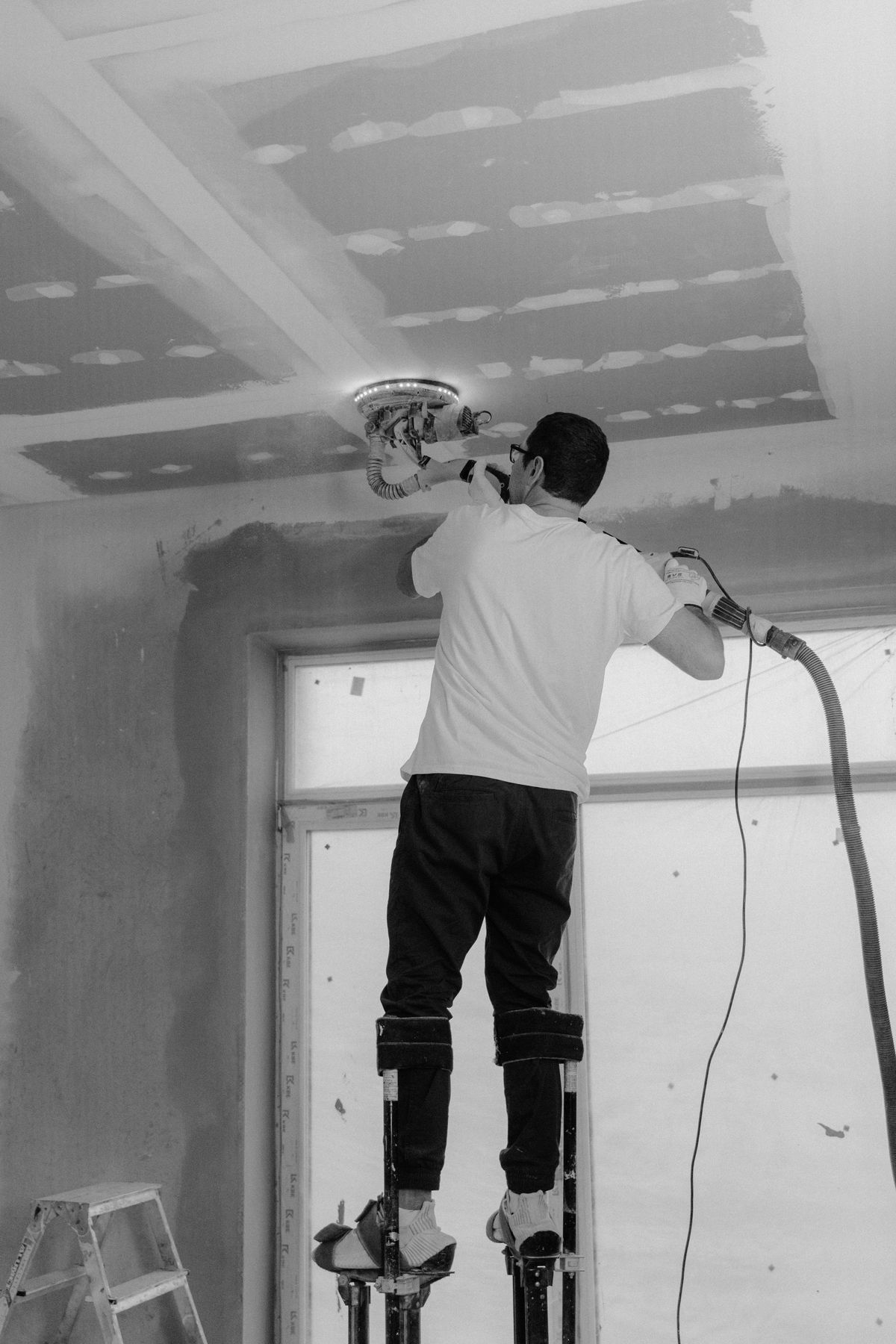
Eight-foot flat ceilings are fast. Vaulted great rooms, stairwell walls, tray ceilings, skylight wells, and anything requiring planks or scaffolding all slow scraping and finishing considerably.
5. Your finish choice
Knockdown and orange peel are forgiving — the texture hides small imperfections, so two coats and a spray gun finish it. A dead-flat level-5 smooth ceiling needs an extra skim pass, more careful sanding, and often a coat of high-build primer, which typically adds a day on a whole house.
6. Living in it
Room-by-room phasing around an occupied home is slower than an empty one — furniture moves twice, the crew reseals containment daily, and some rooms have to be usable each night. It's completely workable, just not the fastest version. See staying home during ceiling removal.
What Makes It Faster Here
Tucson has two genuine schedule advantages. Our housing stock is overwhelmingly single-story, so crews work off stilts and short ladders instead of staging scaffolding — that alone saves setup hours per room. And for most of the year our air is extremely dry, which is the single biggest lever on joint compound drying time. A skim coat that needs a full overnight in a humid climate is often sandable the same afternoon here in April.
The exception is worth planning around: during monsoon season, roughly June 15 through September 30, dew points climb and interior humidity rises with them. Compound genuinely dries slower in late July than in January, and a whole-house job scheduled in the middle of monsoon can run half a day to a day longer than the same job in spring. It's not a reason to avoid summer — it's a reason not to promise your in-laws the guest room is ready by Friday.
Why a One-Day Whole-House Quote Is a Red Flag
Scraping a whole house in a day is possible. Finishing one in a day is not, because compound has to dry. If a bid promises a completed, painted, smooth whole-house ceiling in a single day, one of three things is true: they're skipping containment, they're applying one thick coat instead of two or three thin ones, or they're not actually including paint. All three show up later — as dust in your ducts, as shrinkage cracks, or as a change order. Ask any suspiciously fast quote to write out the day-by-day sequence.
If You're Doing It Yourself, Multiply by Three
DIY scraping on a small, asbestos-negative room is reasonable, and the scraping itself may genuinely take you an afternoon. The realistic total, though, is usually two or three weekends per room once you count containment, the trip to buy the sprayer you didn't know you needed, the repairs you uncover, three skim coats with dry time in between, sanding, priming, and painting. Homeowners who budget one weekend almost universally finish the scrape and then hire out the finish — which is a perfectly fine outcome, just not the schedule they planned.
Timeline FAQs
How far out do I need to book?
Availability moves with the season — spring listing season and the winter-visitor months are busiest. Plan on a week or two of lead time in normal conditions, plus testing turnaround on older homes. Summer often has the most open calendar.
Can the crew work weekends to finish faster?
Sometimes, but it rarely compresses the schedule much, since the constraint is drying time rather than labor hours. Weekend work helps most when you need the house usable on specific weekdays.
How long until I can put furniture back and use the room?
Usually the same day the paint goes on, once it's dry to the touch — typically a few hours. Give it a day or so before hanging anything or reinstalling a ceiling fan so the paint fully cures.
Does asbestos abatement take longer than normal removal?
Yes, considerably. Regulated work requires full containment, negative air, worker protection, approved disposal, and in many cases a notification filed with the state at least 10 working days before work begins. Budget weeks, not days. More on Arizona's rules.
Does it matter which rooms get done first?
It matters a lot in an occupied home. Sequencing usually starts with the rooms you need least — guest bedrooms and offices — and saves kitchens, primary bedrooms, and the only full bath for when you have a plan for them.
More Tucson Ceiling Guides
Get a Schedule, Not a Guess
A free quote includes a realistic day-by-day sequence for your rooms — so you know when the plastic goes up and when your house is yours again.