Tucson's First Suburb — and Its Oldest Suburban Ceilings
Sam and Giaconda Nanini arrived in Tucson from Chicago in 1948, and beginning in the mid-1950s Sam developed three subdivisions across roughly 300 acres of former citrus land that became the heart of Casas Adobes. Many people consider it Tucson's first true suburb. The houses were built of adobe brick, which is where the name came from, and the Casas Adobes Plaza he built alongside them — Italian sculpture, fountains, a Mediterranean observation tower — still anchors the corner at Oracle and Ina. Maurice Reid's citrus ranches had covered the same ground before him; he sold the last of his land in 1950.
Growth spread out from there through the 1960s and 70s along Ina Road, Orange Grove, Magee, Shannon, and La Cholla, filling in ranch houses, patio homes, and low-slung territorial builds on generous lots. Today the Casas Adobes census area covers about 27 square miles with a population near 71,000, wrapped between Oro Valley to the north and the Catalina Foothills to the east. It is still unincorporated: residents voted to incorporate in 1997, but appeals overturned the law on constitutional grounds and the Superior Court annulled it, leaving Casas Adobes under Pima County jurisdiction to this day.
All of that history lands directly overhead. Casas Adobes has a higher concentration of genuinely pre-1980 housing than almost any suburb in the metro, and that is precisely the era when spray-applied acoustic texture was standard and asbestos had not yet been pushed out of these products — a shift that only came in the late 1970s, with existing stock installed for years afterward. On a Casas Adobes home from the 1950s, 60s, or 70s, a lab test before anything is disturbed is not an upsell or an abundance of caution. It is step one, every time.
What Makes Casas Adobes Ceiling Work Different
- Adobe and masonry walls, drywall ceilings. These houses mix materials in ways tract homes do not. Ceilings are drywall or gypsum board over joists, but they meet adobe, block, and plaster at the perimeter, and repairs have to respect each material rather than treating everything as modern drywall.
- Low, flat 1950s and 60s ceilings. Eight-foot ranch ceilings are where heavy texture does the most damage visually — it eats light and drops the apparent height of every room. Going smooth in one of these houses changes the feel more than in any newer floor plan.
- Decades of owner work. Much of Casas Adobes has no HOA, which has meant sixty years of freedom to repaint, patch, and add. Popcorn painted over two or three times is common here, and painted texture resists water and takes real effort to remove — a cost factor that belongs in the quote, not in a mid-job surprise.
- Swamp cooler scars. Homes of this era were built for evaporative cooling, and the conversion to refrigerated air left capped roof openings, patched ceiling penetrations, and old drip stains. Those want real drywall repair before any new finish goes over them.
- Later infill has vaults. The 1970s and 80s builds toward La Cholla and Magee brought vaulted great rooms and exposed beams. Scraping cleanly up to a stained beam line without splattering it is detail work, and it is priced as such.
Selling a Casas Adobes Home? Ceilings Are Cheap Leverage
Casas Adobes listings compete against updated homes in Oro Valley and the Catalina Foothills, and buyers touring a mid-century ranch with original ceilings read "original condition" instantly. Worse, popcorn on a house this age reliably triggers asbestos questions during the inspection period, which is a far more expensive conversation to have under contract than before listing. Removing the texture, documenting the lab result for your disclosure file, and adding fresh flat ceiling paint changes every listing photo for a fraction of what a kitchen or bath update costs.
Common Casas Adobes Projects
Mid-century ranch, whole house
Test, contain, wet scrape, skim, retexture, and paint across a 1,400–2,200 sq ft single-story. Typically 3–5 working days with fast desert drying between coats.
Cover-over when a test is positive
Capping the ceiling with new drywall over sound, undisturbed texture is often the most affordable safe path — modern ceilings without abatement pricing, and the quote lays out both options.
Painted popcorn removal
The most common Casas Adobes complication. Sealed texture will not absorb water the way raw acoustic does, so the method and the timeline change — and the price says so up front.
Partial-house matching
A previous owner scraped the living room and stopped. Finishing the rest and blending the texture so the whole house reads as one job is a frequent call here.
Light Is the Reason These Ceilings Bother People
Mid-century Tucson builders sited houses for the sun and then framed them low, and Casas Adobes is full of the result: eight-foot flat ceilings over rooms with deep patios, clerestory openings, and long walls of west-facing glass. That raking afternoon light is exactly what popcorn texture handles worst. Every bump throws a small shadow, old water rings and repairs read twice as obvious as they would under diffuse light, and the whole ceiling plane visually drops toward you. The rooms feel dimmer and lower than their dimensions say they should.
Flattening the ceiling reverses all of it at once. A smooth or lightly textured white surface bounces that same light back down evenly instead of breaking it into shadow, and the ceiling stops being something the eye catches on. In a low mid-century ranch it is genuinely the highest-impact change available short of moving walls, and it costs a fraction of what it looks like it cost.
Timing, Access, and Living Through It
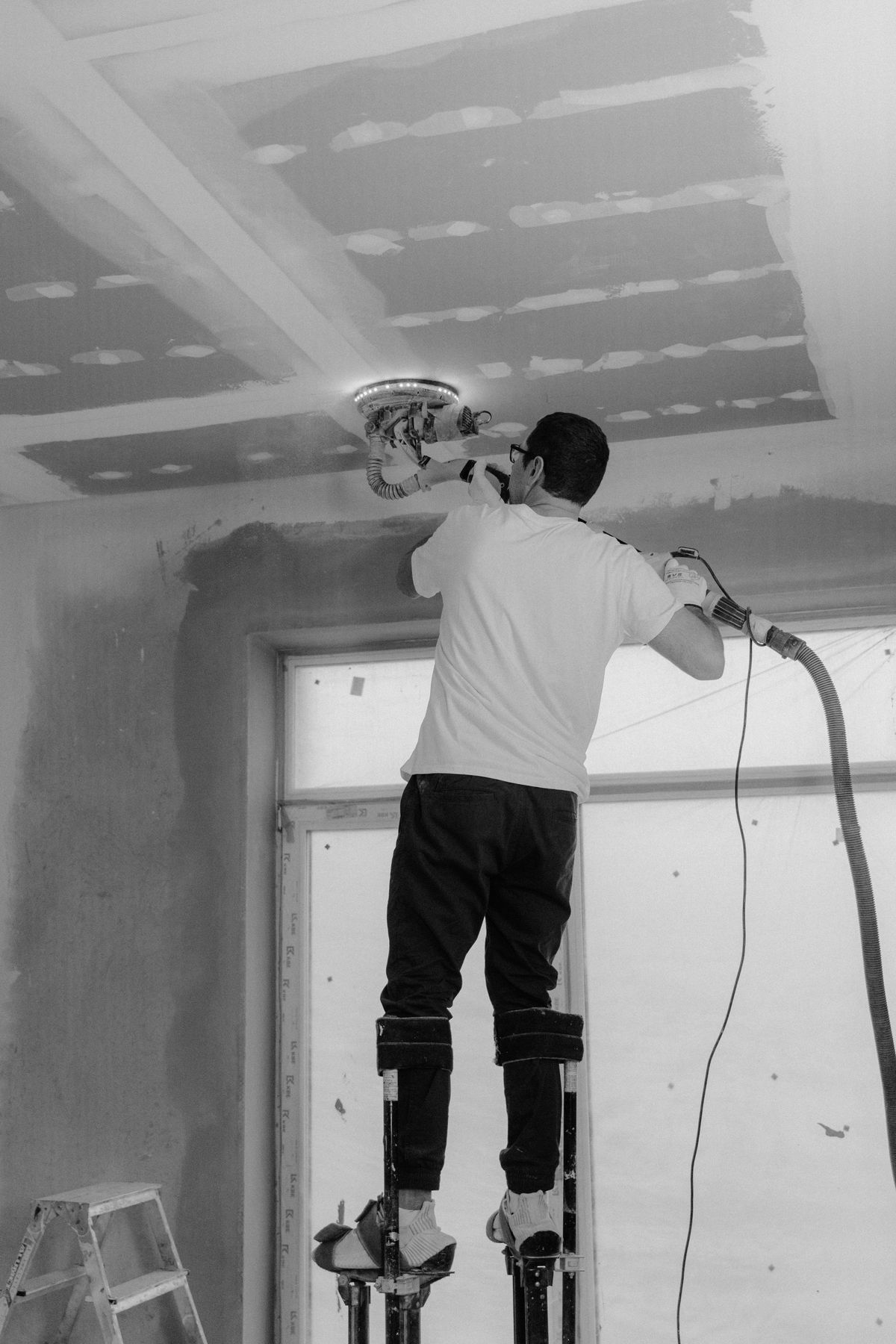
Casas Adobes projects are rarely empty flips — these are long-held family homes with furniture, art, and full closets. That makes containment the whole game: plastic on floors and walls, sealed doorways, covered registers so nothing travels through the ducts, and room-by-room staging so the house stays livable. Daily cleanup is genuinely daily, and debris leaves in a covered trailer rather than sitting in the driveway.
Two local practicalities help. Lots here are big and mature, which means room to stage equipment without crowding a neighbor. And because Casas Adobes sits only eight to ten miles northwest of downtown Tucson, right along the Oracle Road corridor, there is no meaningful travel premium in any honest quote — it is as central as service territory gets. If a larger remodel is on your horizon, sequence the ceilings first: scraping and skim work is far cheaper before new flooring and cabinetry need protecting.
Casas Adobes FAQs
Our house is from 1962 and has never been tested. Where do we start?
With lab samples. It is a quick, inexpensive first step, and on a 1962 house it is essential before anyone scrapes anything. If the result is negative, the project proceeds as routine work. If it is positive, you get honest options — leave it, cover it, or licensed abatement — with real prices for each. How testing works.
Will scraping damage our adobe walls?
It should not. The work happens at the ceiling plane, and walls are masked and protected before anything starts. Where a ceiling meets adobe or plaster directly, the transition is cut and finished by hand rather than run over with a machine.
Which parts of Casas Adobes do you cover?
All of it — the original Nanini subdivisions near Casas Adobes Plaza, the Ina Road and Orange Grove corridors, La Cholla, Magee, Shannon, and the neighborhoods running up to the Oro Valley line and east toward the Foothills, plus Marana to the northwest.
How long does a whole Casas Adobes ranch house take?
A typical 1,400–2,200 sq ft single-story runs about 3–5 working days once testing is back: a day to contain and scrape, one to two for skim coating and drying, and a final day for texture and paint. Painted-over texture and positive lab results both extend that, and the quote should say so before the calendar is set.
Do we need a Pima County permit for this?
Routine interior ceiling refinishing generally does not require a building permit. Asbestos work is a separate matter with its own state rules and notification thresholds, which is one more reason the test result comes before the plan. Your contractor should walk you through what applies to your specific job.
Free Quotes in Casas Adobes
Test first, quote honestly, contain completely — from a licensed, insured local ceiling professional who knows these houses.